Product details description
Lock washers play a critical role in securing hex bolts in applications
where vibration, thermal expansion, or mechanical stress could cause loosening
over time. Hex bolts are widely used in construction, machinery, and equipment
assembly for their strong clamping force, but without proper locking mechanisms,
they can gradually loosen, leading to structural instability or equipment
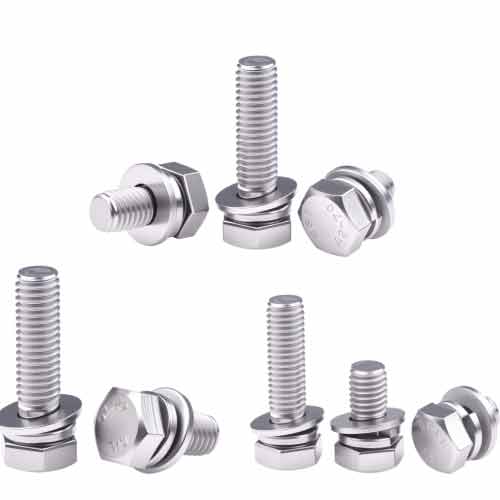
failure. Lock washers address this issue by creating friction between the bolt
head/nut and the mating surface, preventing rotational movement.
There are two primary types of lock washers, each suited to specific
applications: split lock washers (also known as spring washers) and toothed lock
washers. Split lock washers feature a split design that creates tension when
compressed, digging into the surface to resist loosening—ideal for light to
medium-duty applications with soft or non-ferrous materials. Toothed lock
washers (internal or external) have sharp teeth that embed into the mating
surface, providing superior grip for heavy-duty or high-vibration environments
(e.g., machinery, automotive parts). When used with hex bolts, lock washers are
installed between the bolt head/nut and the workpiece, ensuring the clamping
force remains consistent even under stress.
Proper installation and material selection maximize the effectiveness of
lock washers with hex bolts. Choose a lock washer size that matches the hex bolt
diameter (e.g., 1/2-inch washer for 1/2-inch bolt) to ensure full contact and
even pressure. For corrosive environments, use galvanized or stainless steel
lock washers to prevent rust, which can compromise friction and performance.
Avoid over-tightening hex bolts, as this can flatten the lock washer and reduce
its tension. Inspect lock washers regularly for wear or deformation, replacing
them if they no longer provide sufficient tension. When paired correctly with
hex bolts, lock washers provide a reliable, cost-effective solution for
preventing loosening, ensuring the longevity and safety of assembled structures
and equipment.
Previous article:
Socket Head vs Hex Head Bolts: Tool Access and Installation Efficiency
Next article:
Metric Hex Bolts - Precision Threads for Machinery & Equipment