Precision Fastening in Compact Assemblies Using Hex Bolt M8
Release time:2026-03-05 Click:9
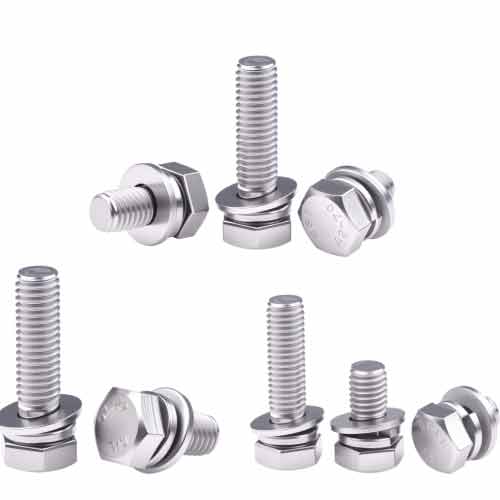
In mechanical engineering, automotive repair, and industrial machinery, the hex bolt M8 serves as a fundamental yet critical fastener—offering a perfect balance between tensile strength, compact size, and ease of installation. With a nominal diameter of 8 millimeters and a standard coarse thread pitch of 1.25 mm, this metric bolt is engineered for applications where space is limited but reliability is non-negotiable.
Manufactured from carbon steel (Grade 8.8 or 10.9), stainless steel (A2/304 or A4/316), or alloy variants for high-temperature environments, the hex bolt M8 can withstand shear loads up to 20 kN and tensile forces exceeding 15 kN when properly torqued. Its six-sided head allows for high-torque application using wrenches or socket drivers without rounding—a key advantage over Phillips or Torx screws in vibration-prone settings like engine blocks or conveyor frames.
Common uses span electric motor mounts, hydraulic manifolds, robotics joints, and bicycle components. In modular furniture assembly, M8 bolts provide hidden structural integrity beneath sleek surfaces. When paired with lock washers, nylon-insert locknuts, or thread-locking adhesives (e.g., Loctite 242), they resist loosening from thermal cycling or dynamic motion.
Installation best practices include cleaning threads, applying anti-seize compound in corrosive environments, and torquing to manufacturer specifications—typically 20–25 Nm for Grade 8.8. Over-torquing risks thread stripping or bolt necking; under-torquing invites fatigue failure. For blind holes, fully threaded variants ensure engagement depth without bottoming out.
In conclusion, the hex bolt M8 exemplifies how standardized fasteners enable global interoperability and precision engineering. Though small, it anchors systems where failure could cascade—from medical devices to aerospace subassemblies—proving that true strength often lies in measured restraint.
Previous article:Strong, Reliable, Versatile – Hex Bolt
Next article:Understanding Black Bolt Systems for Demanding Applications
Hot products
Mobile: +86 15369229308
Email:metalproducts2025@163.com
Email:565169797@qq.com